
electronics-journal.com
02
'26
Written on Modified on
Transparent force and touch sensing film for HMIs
A joint Nanomade–PolyIC development combines printed electronics and force detection to support transparent user interfaces in automotive, medical and consumer devices.
www.nanomade.com
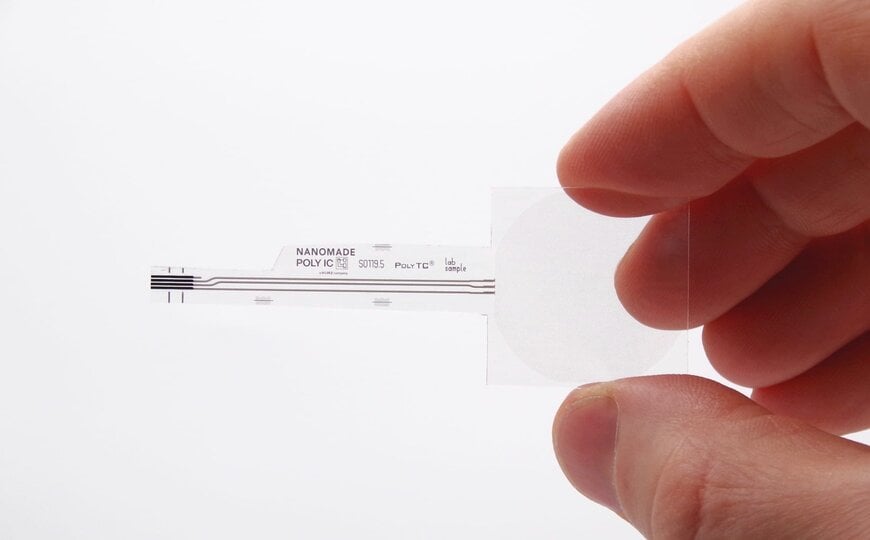
Transparent user interfaces are increasingly used in automotive interiors, medical equipment and consumer electronics where glass or illuminated surfaces replace mechanical controls. In this context, Nanomade and PolyIC developed a transparent sensing film combining capacitive touch detection with force sensing for human-machine interface (HMI) applications.
Combining printed electronics with force sensing layers
The technology combines PolyIC’s transparent flexible capacitive film with Nanomade’s nanoparticle-based sensing ink to enable both touch and deformation detection within the same transparent substrate.
PolyIC manufactures the base film using printed transparent conductive electrodes for capacitive sensing. Nanomade adds a force sensing layer based on its nanoparticle ink technology, enabling pressure detection without adding opaque components.
This architecture results in a flexible and transparent sensing stack designed to maintain optical clarity and light transmission while integrating two interaction modalities typically implemented separately in HMI electronics.
Addressing limitations of conventional capacitive interfaces
Standard capacitive touch interfaces can experience reliability limitations in environments involving moisture, gloves or unintended contact. By adding force sensing, the combined architecture allows systems to distinguish between light touch and intentional press inputs.
This sensing combination enables operation with gloves, more stable interaction in humid or wet environments, reduced unintended activations and improved detection of deliberate user input. These characteristics are relevant for automotive controls, industrial interfaces and medical equipment where interaction reliability is critical.
The addition of force detection also enables gradual haptic feedback strategies based on pressure thresholds, supporting more controlled interaction responses in embedded interface systems.
Integration into illuminated and curved interface designs
The sensing film is designed as a flexible stack that can be laminated beneath existing display or interface assemblies. This approach enables integration into current HMI electronics without major redesign of mechanical or electronic architectures.
The transparent structure supports “hidden-until-lit” controls, integration into illuminated display surfaces and implementation in curved or three-dimensional interface geometries. These characteristics are relevant in automotive interior electronics, smart appliances and display-integrated control panels.
Application scope across multiple device categories
The transparent Force & Touch film is intended for integration into several device categories, including consumer electronics such as laptops and wearable devices, automotive interior control panels, smart home and appliance interfaces, and medical control systems requiring glove-compatible interaction surfaces.
Edited by industrial journalist Aishwarya Mambet, with AI-assistance.
www.nanomade.com
