
electronics-journal.com
12
'26
Written on Modified on
Motion profile selection in precision motion control
INMOCO outlines how trajectory design choices influence positioning accuracy, machine throughput and stability across servo-driven automation and digital supply chain equipment.
www.inmoco.co.uk
Motion profile design determines how precisely and efficiently motor-driven axes move in automated machinery, affecting vibration, positioning accuracy and cycle times in sectors such as robotics, semiconductor handling and laboratory automation. In this context, Gerard Bush, an engineer at motion specialist INMOCO, detailed engineering considerations for selecting and tuning motion profiles in servo and stepper motor applications.
Motion profile mathematics remains relevant despite automated controllers
A motion profile defines how position, velocity and acceleration evolve over time along a motor axis. In industrial automation, this typically applies to closed-loop motion systems where feedback from encoders or sensors is used to maintain positioning accuracy.
Modern motion controllers and servo drives can automatically generate trajectories based on input constraints such as travel distance, maximum velocity and acceleration limits. However, relying solely on controller-generated profiles may introduce unwanted effects such as overshoot, vibration, positional deviation or extended settling times, depending on the assumptions built into predefined algorithms.
Understanding the mathematical structure of motion profiles allows engineers to tune performance parameters more precisely, particularly during commissioning and optimisation phases. This can help reduce commissioning time and maintain long-term stability once equipment is deployed in production environments.
Trade-offs between trapezoidal and S-curve trajectories
Point-to-point motion remains one of the most common movement patterns in industrial machines. In this approach, the axis accelerates from rest, maintains constant velocity and then decelerates to a stop at the target position.
A trapezoidal motion profile achieves this through three phases: linear acceleration, constant velocity and linear deceleration. Because acceleration changes instantaneously between phases, these profiles can minimise commanded move time. A triangular profile, which removes the constant velocity phase, can further shorten move duration.
However, these approaches increase jerk, defined as the rate of change of acceleration. High jerk levels can cause oscillation and vibration, potentially leading to positioning errors and overshoot. Compensating for these effects often requires additional settling time, which can reduce effective machine throughput. Over longer operating periods, repeated mechanical stress from jerk can also contribute to component wear and increased maintenance requirements in maintenance-driven production environments.
S-curve motion profiles address this by introducing additional motion phases to smooth acceleration transitions. A typical S-curve consists of seven phases that gradually transition between acceleration states, reducing jerk and improving motion stability.
Although trapezoidal motion profiles may achieve shorter commanded move times, S-curve profiles can improve overall cycle efficiency by reducing vibration at the end of a move and therefore reducing total effective transfer time.
Profile tuning depends on load behaviour and process sensitivity
Motion profile selection depends heavily on application characteristics. For example, high-speed pick-and-place systems with relatively stable loads may use S-curve profiles with short acceleration smoothing phases, typically around 5–15% of the acceleration or deceleration period. This approach prioritises transfer speed while maintaining acceptable vibration levels.
Applications involving sensitive materials may require more aggressive jerk reduction. In medical liquid handling systems, for example, removing constant acceleration phases and maximising smooth transitions can improve process stability by reducing disturbances to the transported media.
Sinusoidal motion profiles extend this principle further. Instead of linear acceleration ramps as used in standard S-curve trajectories, sinusoidal profiles use continuous curves derived from sine functions to ensure gradual acceleration changes. This approach further reduces jerk by eliminating abrupt slope changes in the trajectory.
Custom trajectory development and feedforward control in CNC systems
In some applications, particularly CNC machining, motion profiles may be developed specifically for the load and motor characteristics of a given system. These profiles can be pre-calculated and stored as motion vector tables.
Such tables may also include feedforward parameters, which introduce corrective commands proactively rather than waiting for position errors to occur. This can improve response time and positioning precision, particularly in high-speed or high-accuracy applications.
Optimising motion profiles often requires balancing jerk, transfer time and mechanical factors such as inertia, friction and structural compliance. Because these parameters may only become fully apparent during commissioning, tuning frequently involves iterative adjustment.
Motion control platforms supporting multiple trajectory models
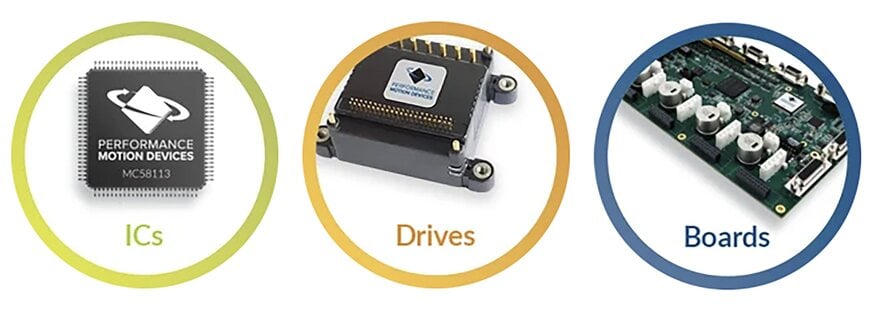
Hardware and software flexibility can influence how effectively motion profiles are implemented. Performance Motion Devices (PMD), for example, provides motion controllers, drives and positioning devices capable of supporting trapezoidal, S-curve and sinusoidal trajectories.
These platforms use the C-Motion® motion control software library to support motion development across applications, including medical systems, laboratory automation, semiconductor equipment and robotics.
Engineering support may also play a role in motion optimisation. INMOCO provides motion engineering services alongside hardware specification support to help balance positioning precision with machine throughput in complex motion applications.
Edited by industrial journalist, Aishwarya Mambet — AI-powered.
www.inmoco.com
