
electronics-journal.com
11
'26
Written on Modified on
Single-chip Wi-Fi 7 SoC targets edge AI IoT
Synaptics introduces a wireless connectivity and processing platform combining tri-band networking, embedded AI acceleration and sensing capabilities for industrial and consumer IoT devices.
www.synaptics.com
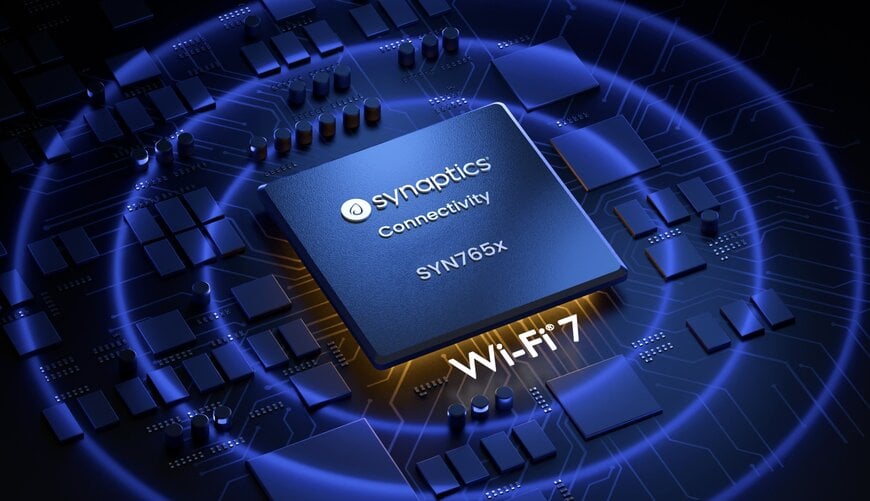
Edge AI devices increasingly combine local processing with high-speed wireless connectivity to reduce latency and cloud dependency in industrial IoT and smart device environments. In this context, Synaptics Incorporated introduced the SYN765x, a single-chip wireless and AI processing solution for embedded IoT edge applications.
Combining connectivity and AI processing on a single chip
The SYN765x integrates Wi-Fi® 7, Bluetooth® LE 6.0 and Thread/Zigbee connectivity across the 2.4 GHz, 5 GHz and 6 GHz bands into a single device. The architecture also incorporates dedicated hardware acceleration for predefined AI-optimised signal processing and control tasks, reducing host CPU workload while supporting latency and power consumption constraints typical of embedded edge AI systems.
The device includes integrated logic resources, DSPs and NPUs designed to support embedded AI inference workloads locally. This architecture allows IoT devices to process contextual data at the edge rather than relying exclusively on cloud infrastructure, supporting distributed computing approaches common in the digital supply chain and industrial automation environments.
Wireless performance designed for embedded edge devices
The single-chip integration reduces system footprint and removes the need for multiple discrete components, which can simplify hardware design and reduce overall bill-of-materials costs. The component also integrates low-noise amplifiers (LNA), power amplifiers (PA) and transmit/receive switches.
Wi-Fi 7 features include support for reduced latency, band switching, reconnection mechanisms and access to the 6 GHz spectrum. The device supports sustained data rates of 20 Mbps at distances of up to 200 metres under specified conditions.
The SYN765x can operate either as a coprocessor alongside a host application processor or as a standalone processing platform using onboard memory and compute resources. This flexibility allows device manufacturers to eliminate separate microcontrollers in certain designs.
Wireless sensing capabilities expand device functionality
The platform also introduces wireless sensing functions using standard Wi-Fi and Bluetooth signals. These include presence detection, motion tracking and proximity sensing.
For Wi-Fi sensing, the solution combines Channel State Information (CSI) extraction with embedded machine learning models to support environmental awareness functions. Bluetooth Channel Sounding enables distance measurement using wireless signals, offering an alternative approach to distance sensing technologies such as millimetre-wave radar or ultra-wideband in applications where cost and power consumption are design constraints.
AI-driven contextual analytics are also used to optimise energy usage by adapting device behaviour based on sensed environmental conditions.
Integration approach for next-generation connected devices
The SYN765x combines wireless communication, sensing and embedded AI processing into a single hardware platform intended for smart home systems, industrial IoT infrastructure and connected edge devices requiring local intelligence and multi-protocol connectivity.
www.synaptics.com
Edited by industrial journalist, Aishwarya Mambet — AI-powered.
