
electronics-journal.com
09
'26
Written on Modified on
ESD-Safe PCB Conveyor System for Electronics Manufacturing
Schnaithmann Maschinenbau delivers an adjustable conveyor system designed for electrostatically sensitive environments in automotive electronics production.
www.schnaithmann.de
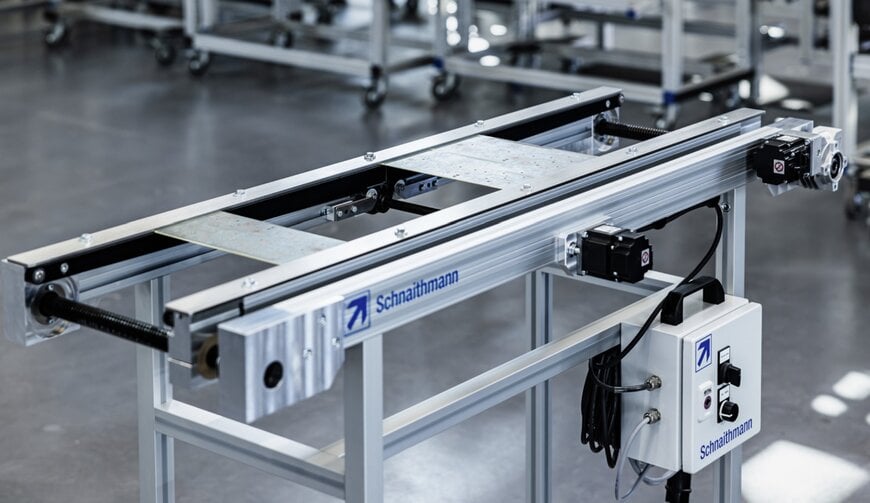
Module of the circuit board conveyor system from Schnaithmann for gentle transport in ultra-high ESD-sensitive areas. Speed and width are infinitely adjustable.
Manufacturing electronic control units requires carefully controlled handling systems to prevent electrostatic discharge and mechanical damage to sensitive components. In this context, Schnaithmann Maschinenbau GmbH delivered a printed circuit board conveyor system designed for safe transport in ultra-ESD-sensitive production areas at an automotive supplier facility.
Handling sensitive electronics in ultra-ESD production environments
Production of vehicle electronics, control units, and networked automotive systems involves printed circuit boards (PCBs) that are highly sensitive to electrostatic discharge. Even minor electrostatic events can damage semiconductor components or reduce long-term reliability.
The conveyor system supplied by Schnaithmann Maschinenbau GmbH was developed specifically for use in an ultra-ESD-sensitive area, where strict electrostatic protection standards apply. All materials used in the system—including belts, guide rails, aluminium profiles, and structural components—are designed to comply with ESD protection requirements.
Such design considerations are essential in electronics manufacturing environments where PCB transport systems must maintain electrical neutrality while ensuring stable mechanical handling.
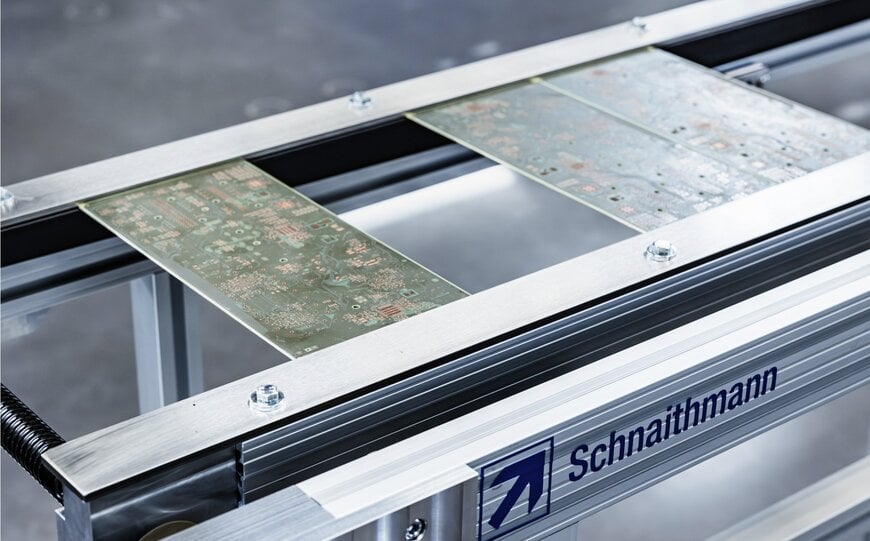
Details of the circuit board conveyor: the materials of the belts, guide rails, aluminum profiles and other components are ESD-compatible in combination.
Adjustable transport for circuit boards with varying dimensions
A key engineering challenge in the system design involved handling printed circuit boards with minimal contact areas and varying widths. To address this requirement, the conveyor incorporates a continuously adjustable width mechanism that adapts to different board dimensions.
The adjustment is achieved through a servo motor combined with a trapezoidal lead screw, enabling operators to set the conveyor width precisely for each PCB format. This mechanism allows the conveyor system to maintain stable guidance even when transporting boards with different sizes.
The conveyor’s transport speed is also infinitely adjustable, allowing operators to adapt handling conditions to the sensitivity and weight of the circuit boards. Controlled speed and stable positioning help reduce vibration and mechanical stress during transport.
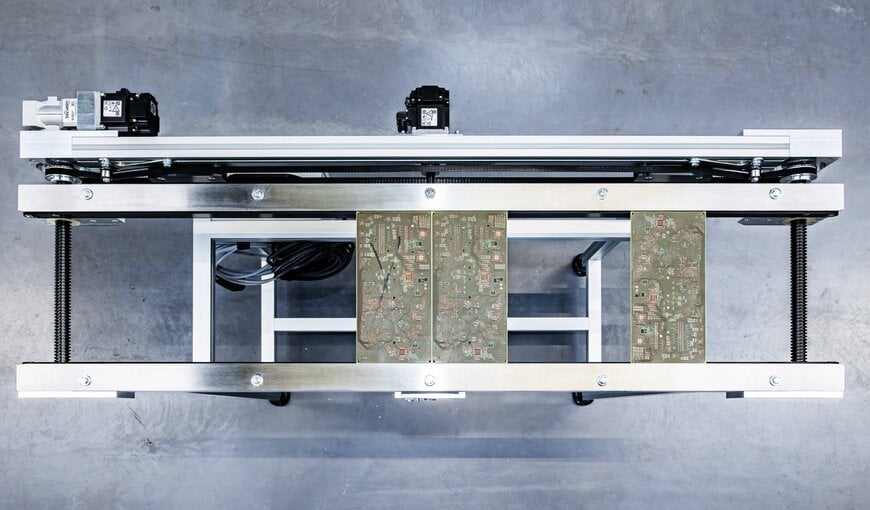
Top view of a module of the Schnaithmann circuit board conveyor system. The width can be adjusted to the dimensions of the circuit boards via a small servo motor and a trapezoidal lead screw.
Slim conveyor design for flexible electronics production lines
The conveyor system features a slim mechanical design, enabling integration into compact production lines where space is limited. Such configurations are common in electronics assembly environments where multiple handling systems must operate in close proximity.
By combining adjustable width and variable speed control, the conveyor supports flexible production workflows in automotive electronics manufacturing, where PCB formats and production volumes may change frequently.
Modular conveyor technology for specialized production environments
Schnaithmann develops conveyor systems covering a wide range of industrial transport tasks, from moving small lightweight components to handling heavier assemblies. The company’s modular conveyor architecture allows systems to be configured with different belt types, drives, and materials depending on the requirements of the production environment.
These configurations can support a variety of industrial conditions, including cleanroom environments, FDA-compliant transfer systems for food and pharmaceutical processing, dry production areas used in battery manufacturing, and heat-intensive industrial processes.
Such modular designs allow conveyor systems to be adapted to specific process requirements while maintaining stable material handling within modern manufacturing environments.
www.schnaithmann.com
Edited by industrial journalist, Aishwarya Mambet.
Manufacturing electronic control units requires carefully controlled handling systems to prevent electrostatic discharge and mechanical damage to sensitive components. In this context, Schnaithmann Maschinenbau GmbH delivered a printed circuit board conveyor system designed for safe transport in ultra-ESD-sensitive production areas at an automotive supplier facility.
Handling sensitive electronics in ultra-ESD production environments
Production of vehicle electronics, control units, and networked automotive systems involves printed circuit boards (PCBs) that are highly sensitive to electrostatic discharge. Even minor electrostatic events can damage semiconductor components or reduce long-term reliability.
The conveyor system supplied by Schnaithmann Maschinenbau GmbH was developed specifically for use in an ultra-ESD-sensitive area, where strict electrostatic protection standards apply. All materials used in the system—including belts, guide rails, aluminium profiles, and structural components—are designed to comply with ESD protection requirements.
Such design considerations are essential in electronics manufacturing environments where PCB transport systems must maintain electrical neutrality while ensuring stable mechanical handling.
Details of the circuit board conveyor: the materials of the belts, guide rails, aluminum profiles and other components are ESD-compatible in combination.
Adjustable transport for circuit boards with varying dimensions
A key engineering challenge in the system design involved handling printed circuit boards with minimal contact areas and varying widths. To address this requirement, the conveyor incorporates a continuously adjustable width mechanism that adapts to different board dimensions.
The adjustment is achieved through a servo motor combined with a trapezoidal lead screw, enabling operators to set the conveyor width precisely for each PCB format. This mechanism allows the conveyor system to maintain stable guidance even when transporting boards with different sizes.
The conveyor’s transport speed is also infinitely adjustable, allowing operators to adapt handling conditions to the sensitivity and weight of the circuit boards. Controlled speed and stable positioning help reduce vibration and mechanical stress during transport.
Top view of a module of the Schnaithmann circuit board conveyor system. The width can be adjusted to the dimensions of the circuit boards via a small servo motor and a trapezoidal lead screw.
Slim conveyor design for flexible electronics production lines
The conveyor system features a slim mechanical design, enabling integration into compact production lines where space is limited. Such configurations are common in electronics assembly environments where multiple handling systems must operate in close proximity.
By combining adjustable width and variable speed control, the conveyor supports flexible production workflows in automotive electronics manufacturing, where PCB formats and production volumes may change frequently.
Modular conveyor technology for specialized production environments
Schnaithmann develops conveyor systems covering a wide range of industrial transport tasks, from moving small lightweight components to handling heavier assemblies. The company’s modular conveyor architecture allows systems to be configured with different belt types, drives, and materials depending on the requirements of the production environment.
These configurations can support a variety of industrial conditions, including cleanroom environments, FDA-compliant transfer systems for food and pharmaceutical processing, dry production areas used in battery manufacturing, and heat-intensive industrial processes.
Such modular designs allow conveyor systems to be adapted to specific process requirements while maintaining stable material handling within modern manufacturing environments.
www.schnaithmann.com
Edited by industrial journalist, Aishwarya Mambet.
