
electronics-journal.com
09
'26
Written on Modified on
Microchip Introduces Atomic Clock for GNSS-Denied Timing
A compact chip-scale atomic clock improves frequency stability, warm-up performance and temperature tolerance for precise timing in military, industrial and remote sensing systems.
www.microchip.com

Precision timing solutions for defense, sensing and industrial systems
Precise timing is essential in sectors such as defense electronics, remote sensing, satellite navigation backup systems and industrial instrumentation, where systems must maintain accurate synchronization even when Global Navigation Satellite Systems (GNSS) signals are unavailable. To address this requirement, Microchip Technology Inc. has introduced a new chip-scale atomic clock designed to provide stable frequency references in environments where external timing signals cannot be relied upon.
The new clock provides an embedded timing solution intended for portable platforms that require high accuracy, low power consumption and reliable operation in harsh environments. Such timing devices are commonly integrated into systems for navigation resilience, communications infrastructure and measurement equipment.
Improved stability and faster start-up in extreme temperatures
The atomic clock operates over a temperature range from −40 °C to 80 °C, with storage capability from −55 °C to 105 °C, allowing it to function in demanding environmental conditions encountered in field-deployed equipment.
Compared with the company’s previous generation chip-scale atomic clock, the device provides approximately double the frequency stability across its temperature range. Frequency stability is a critical parameter in timing systems because it determines how accurately a clock can maintain synchronization over time without external references.
Another improvement concerns cold-start operation. The new device reaches operating frequency within two minutes at −40 °C, representing roughly a 33% faster warm-up time compared with the earlier model. Faster warm-up allows equipment to begin operation more quickly after startup in cold environments, which is important for portable or intermittently powered systems.
Timing accuracy for GNSS-denied environments
Chip-scale atomic clocks are designed to maintain precise timing during periods when satellite timing signals are unavailable or intentionally blocked. This capability is particularly relevant for assured positioning, navigation and timing (A-PNT) systems used in military platforms and critical infrastructure.
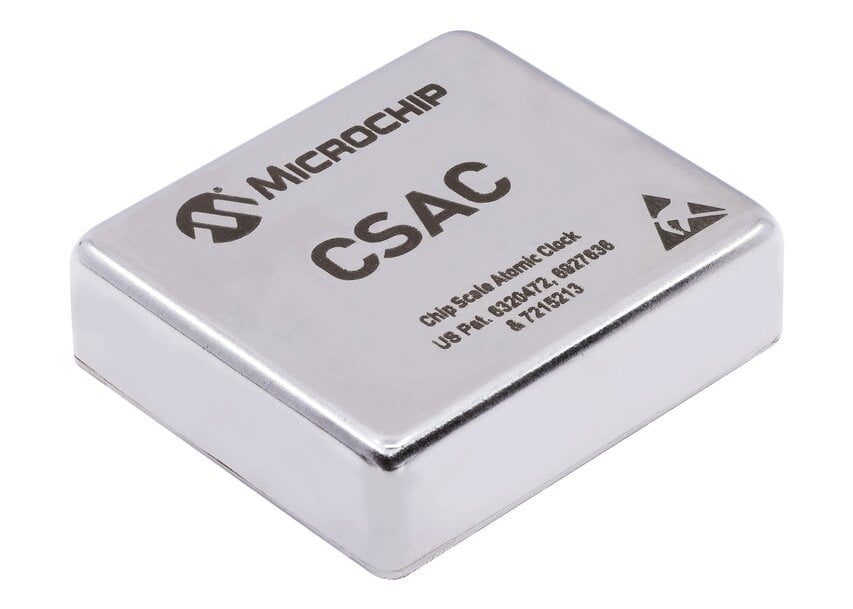
The device is also designed for systems in the C5ISR domain—command, control, communications, computers, cyber, intelligence, surveillance and reconnaissance—where synchronized timing signals support secure communications, sensor coordination and data processing.
In these applications, accurate internal frequency references allow systems to maintain synchronized operations for extended periods without GNSS input.
Low size, weight and power for portable platforms
Atomic clocks traditionally required large and power-intensive hardware. Chip-scale atomic clock technology reduces these constraints by integrating the atomic reference and supporting electronics into a compact module designed for low size, weight and power (SWaP) requirements.
The new clock is also compatible in form, fit and function with the company’s earlier chip-scale atomic clock generation, allowing system developers to upgrade performance without redesigning their hardware architecture. This compatibility helps reduce development time and integration risk when improving existing designs.
Development support for system integration
To support evaluation and system development, the atomic clock family is compatible with a dedicated developer kit that includes software tools, documentation and technical support resources. These tools allow engineers to integrate the timing module into navigation systems, communication devices and industrial measurement platforms.
Chip-scale atomic clocks are increasingly used in applications where precise timing must be maintained independently of satellite signals, including navigation resilience systems, distributed sensing networks and scientific instrumentation operating in remote locations.
www.microchip.com
Edited by Industrial Journalist, Natania Lyngdoh.
Powered by AI.
