
electronics-journal.com
02
'26
Written on Modified on
MediaTek Showcases 6G and Edge AI at MWC 2026
Demonstrations span 6G interoperability, 5G-Advanced CPE with Wi-Fi 8, automotive connectivity, edge AI devices and high-bandwidth data center interconnects.
www.mediatek.com
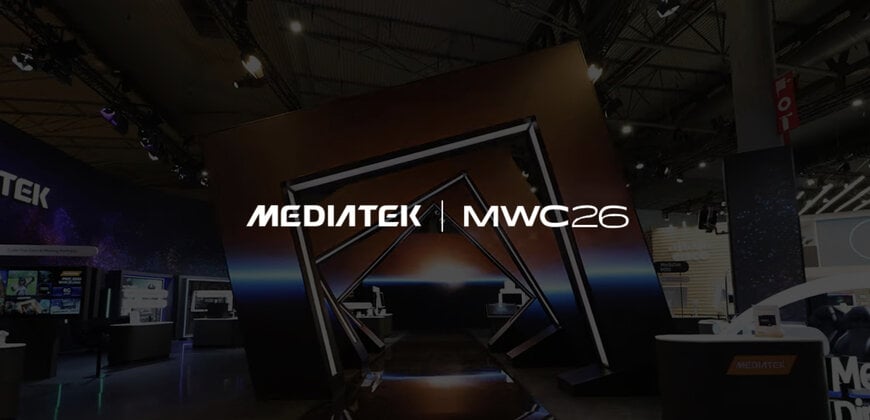
Telecommunications operators, device manufacturers and data center architects are accelerating the convergence of 6G research, edge AI and high-bandwidth interconnect technologies. At Mobile World Congress 2026 (MWC 2026), MediaTek presented its “AI For Life: From Edge to Cloud” showcase, outlining silicon and system-level developments across wireless infrastructure, consumer devices, automotive platforms and data centers.
A keynote led by MediaTek President Joe Chen was held on March 4 in Hall 8, alongside booth demonstrations covering 6G communications, 5G-Advanced customer premises equipment (CPE), automotive chipsets and die-to-die interconnect solutions.
6G radio interoperability and AI-enhanced uplink performance
Within early 6G development, MediaTek demonstrated radio interoperability designed to balance throughput, latency and power efficiency. The company also introduced AI-accelerated uplink transmit diversity (TxD), where machine learning dynamically adapts transmission behavior based on network conditions, replacing conventional rule-based optimization.
This approach aims to support emerging generative and agentic AI services requiring deterministic low latency and stable uplink performance. MediaTek also described a “personal device cloud” concept, enabling AI agents to collaborate across devices over Wi-Fi or 6G connections within a unified computing environment.
For robotics and industrial edge applications, 6G integration with edge computing services is positioned to deliver compute-intensive workloads with reduced round-trip delay, improving responsiveness in mobile or autonomous systems.
5G-Advanced CPE with Wi-Fi 8 and AI network engine
MediaTek showcased a 5G-Advanced CPE device integrating a 3GPP Release 18 modem with Wi-Fi 8 capability. The system incorporates eight receive antennas, increasing spectrum efficiency by more than 40%, and three transmit antennas with five MIMO layers, improving uplink throughput by 40%.
An embedded AI network engine supports AI-driven L4S (Low Latency, Low Loss, Scalable Throughput) and AI-based QoS management. According to MediaTek, the system can deliver up to 10× lower latency for L4S-enabled and legacy applications without requiring modifications to the core or application backend infrastructure. Such capabilities are particularly relevant for cloud gaming, real-time collaboration and AI-assisted services operating over fixed wireless access.
Automotive connectivity and intelligent cockpit platforms
In automotive communications, MediaTek demonstrated a 5G NR NTN (Non-Terrestrial Network) video call, validating satellite-based connectivity for video and broadband services beyond terrestrial network coverage.
A new telematics chipset supporting 5G-Advanced Release 17 and Release 18 standards integrates modem-level AI to improve connection stability. Inside the vehicle, a Dimensity Auto smart cockpit platform fabricated on a 3 nm automotive-grade process node integrates:
- A multi-core CPU based on Arm v9.2 architecture
- Advanced GPU capabilities with ray tracing support
- A dedicated NPU for generative AI voice assistants
The platform is designed to enable AI-driven infotainment, multimodal interaction and privacy-preserving on-device processing within next-generation vehicle architectures.
Edge AI in smartphones and wearable devices
MediaTek highlighted its Dimensity 9500 mobile platform, which integrates a neural processing unit (NPU) for advanced on-device AI inference. Edge processing reduces reliance on cloud backhaul, improving latency and data privacy.
The company also demonstrated AI glasses designed for on-device multimodal processing in collaboration with smartphones. The system leverages a multimodal large model capable of interpreting text, speech, images and video inputs locally.
Die-to-die interconnect and co-packaged optics for data centers
For data center applications, MediaTek introduced an in-house UCIe-Advanced IP for die-to-die interconnect, silicon-validated on 2 nm and 3 nm process technologies. The solution supports bandwidth densities up to 10 terabits per second per millimeter of die edge while targeting ultra-low bit-error rates and low power consumption.
The company also demonstrated a co-packaged optics solution aimed at overcoming copper interconnect limitations. The optical subsystem targets bandwidth speeds up to 400 gigabits per second per fiber, integrating electrical, optical, thermal and mechanical co-design. Such architectures are intended to improve performance per watt and reduce total cost of ownership (TCO) at rack level in AI-driven data centers, where metrics such as tokens per watt and tokens per dollar are becoming increasingly relevant.
HPC and IoT ecosystem demonstrations
Additional demonstrations at the booth included high-performance compute workloads on the NVIDIA DGX Spark platform featuring the NVIDIA GB10 Grace Blackwell Superchip co-designed by MediaTek, IoT applications including an AI interpreter hub, and on-device AI processing for Chromebook systems powered by the Kompanio Ultra platform.
By presenting developments spanning 6G radio interoperability, AI-enhanced wireless networking, automotive-grade compute platforms and high-bandwidth die-to-die interconnect technologies, MediaTek positioned its silicon roadmap around integrated connectivity and AI acceleration from edge devices to cloud-scale infrastructure at MWC 2026.
www.mediatek.com
Edge AI in smartphones and wearable devices
MediaTek highlighted its Dimensity 9500 mobile platform, which integrates a neural processing unit (NPU) for advanced on-device AI inference. Edge processing reduces reliance on cloud backhaul, improving latency and data privacy.
The company also demonstrated AI glasses designed for on-device multimodal processing in collaboration with smartphones. The system leverages a multimodal large model capable of interpreting text, speech, images and video inputs locally.
Die-to-die interconnect and co-packaged optics for data centers
For data center applications, MediaTek introduced an in-house UCIe-Advanced IP for die-to-die interconnect, silicon-validated on 2 nm and 3 nm process technologies. The solution supports bandwidth densities up to 10 terabits per second per millimeter of die edge while targeting ultra-low bit-error rates and low power consumption.
The company also demonstrated a co-packaged optics solution aimed at overcoming copper interconnect limitations. The optical subsystem targets bandwidth speeds up to 400 gigabits per second per fiber, integrating electrical, optical, thermal and mechanical co-design. Such architectures are intended to improve performance per watt and reduce total cost of ownership (TCO) at rack level in AI-driven data centers, where metrics such as tokens per watt and tokens per dollar are becoming increasingly relevant.
HPC and IoT ecosystem demonstrations
Additional demonstrations at the booth included high-performance compute workloads on the NVIDIA DGX Spark platform featuring the NVIDIA GB10 Grace Blackwell Superchip co-designed by MediaTek, IoT applications including an AI interpreter hub, and on-device AI processing for Chromebook systems powered by the Kompanio Ultra platform.
By presenting developments spanning 6G radio interoperability, AI-enhanced wireless networking, automotive-grade compute platforms and high-bandwidth die-to-die interconnect technologies, MediaTek positioned its silicon roadmap around integrated connectivity and AI acceleration from edge devices to cloud-scale infrastructure at MWC 2026.
www.mediatek.com
