
electronics-journal.com
27
'26
Written on Modified on
TDK at Embedded World 2026
From March 10 to 12 in Nuremberg, discover how TDK presents advanced sensors, power supplies, and motor controllers to drive efficiency in automotive, industrial, and smart technology sectors.
www.tdk.com
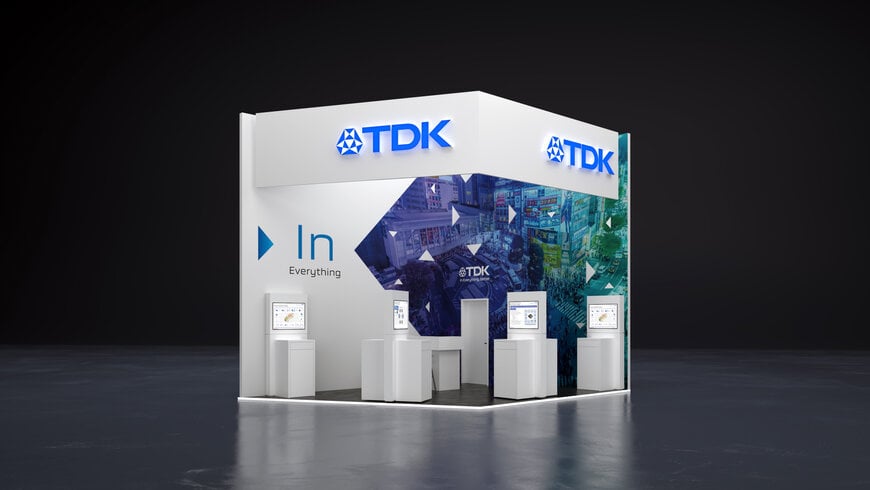
At Embedded World 2026 TDK Corporation will present an expanded range of embedded solutions targeting next-generation industrial, automotive, IoT, and edge computing systems. The demonstrations are structured to address application-level requirements rather than isolated components, emphasizing how integrated and application-ready technologies can simplify complex system design and improve reliability.
Meeting Diverse Embedded Application Demands with Integrated Solutions
The TDK portfolio on display is positioned to respond to multi-domain pressures on embedded designers: tighter power envelopes, rising sensing/actuation complexity, and the need for robust data handling at the edge. Components spanning sensors, motor control, power supplies, and flash storage are presented as system-level building blocks that reduce design effort and optimize performance.
TDK’s approach materially differentiates itself from many traditional suppliers by packaging advanced sensing capabilities alongside power and storage solutions in a unified exhibitor context. This contrasts with competitors that typically present discrete components without demonstration of system interoperability and application mapping, particularly for harsh environment or automotive use cases.
A broad set of sensing technologies addresses precise physical measurement and context awareness across embedded applications:
- Hall-effect and pressure/temperature sensors designed for automotive thermal management and fluid circuits, combining tolerance to magnetic stray fields with reliable integration into mechanical systems.
- Digital MEMS microphones that support advanced acoustic detection functions such as keyword and activity recognition without external processing.
- TMR and inertial measurement fusion that delivers absolute orientation and navigation data for applications requiring reliable motion and heading detection.
- Ultrasonic time-of-flight modules integrated into assistive devices such as smart glasses, where low power consumption and compact form factor enable obstacle detection.
These sensing solutions aim to move beyond basic detection — for instance, offering built-in sensor fusion or environmental robustness — which is increasingly demanded in automotive, wearable, and industrial systems. This emphasis on integrated sensing contrasts with many competitor offerings that focus on individual sensor capabilities without packaged fusion or application demonstration.
Motor control and power conversion technologies on show reflect TDK’s efforts to streamline embedded actuation and power conditioning:
Motor control and power conversion technologies on show reflect TDK’s efforts to streamline embedded actuation and power conditioning:
- Embedded gate driver and motor control ICs that support BLDC motors in thermal management and actuator systems, allowing compact and reliable control without requiring external gate drivers.
- Ruggedized DC-DC converters (RGC and RGA series) covering a wide input voltage range and designed for industrial and medical embedded systems.
- Compact DC-DC converters (CCG and i7A series) tailored for surface-mount or brick footprint applications where board space and thermal performance are constrained.
These power subsystems are oriented to reduce the total system footprint and complexity of embedded motor and power designs, distinguishing TDK’s portfolio against competitors that may emphasize power density but lack ruggedization or broad voltage adaptability.
Flash Storage for Edge and Infrastructure Applications
TDK’s embedded flash storage solutions — including high-reliability SSDs with the GBDriver series and DRAM-less drives with power backup circuits — are targeted at applications requiring sustained operation and data integrity, such as industrial equipment and edge computing platforms. These offerings integrate stable throughput with features that minimize data corruption during power events, a differentiator particularly relevant for mission-critical deployments where competitor products may offer high speed without equivalent focus on reliability under stress.
A practical demonstration with railway infrastructure partners (e.g., a 3D laser radar obstacle detection system) reinforces how these storage technologies function in a real-world embedded environment rather than solely in lab conditions.
Positioning Against Competition
TDK’s exhibition underscores a strategic orientation toward application-aware system components rather than isolated parts. By aligning sensing, motion control, power conversion, and storage within a coherent embedded ecosystem, TDK is addressing the growing designer demand for components that lower integration risk, extend system robustness, and support demanding environments. This direction reflects a broader trend in embedded systems — from pure component selection toward curated solution portfolios — and places TDK’s offerings in contrast to many suppliers that continue to present products in isolation.
For engineers and systems architects evaluating technologies for next-generation embedded designs, the breadth and integration focus of TDK’s portfolio are positioned to answer practical questions about how to manage complexity, reliability, and performance across diverse application domains.
www.tdk-electronics.tdk.com
Flash Storage for Edge and Infrastructure Applications
TDK’s embedded flash storage solutions — including high-reliability SSDs with the GBDriver series and DRAM-less drives with power backup circuits — are targeted at applications requiring sustained operation and data integrity, such as industrial equipment and edge computing platforms. These offerings integrate stable throughput with features that minimize data corruption during power events, a differentiator particularly relevant for mission-critical deployments where competitor products may offer high speed without equivalent focus on reliability under stress.
A practical demonstration with railway infrastructure partners (e.g., a 3D laser radar obstacle detection system) reinforces how these storage technologies function in a real-world embedded environment rather than solely in lab conditions.
Positioning Against Competition
TDK’s exhibition underscores a strategic orientation toward application-aware system components rather than isolated parts. By aligning sensing, motion control, power conversion, and storage within a coherent embedded ecosystem, TDK is addressing the growing designer demand for components that lower integration risk, extend system robustness, and support demanding environments. This direction reflects a broader trend in embedded systems — from pure component selection toward curated solution portfolios — and places TDK’s offerings in contrast to many suppliers that continue to present products in isolation.
For engineers and systems architects evaluating technologies for next-generation embedded designs, the breadth and integration focus of TDK’s portfolio are positioned to answer practical questions about how to manage complexity, reliability, and performance across diverse application domains.
www.tdk-electronics.tdk.com
