
electronics-journal.com
13
'26
Written on Modified on
Life sciences adopt NVIDIA BioNeMo for AI drug discovery
NVIDIA’s BioNeMo platform is being adopted by pharmaceutical companies and research organizations to integrate AI models, laboratory data and automation for scalable, data-driven drug discovery.
www.nvidia.com
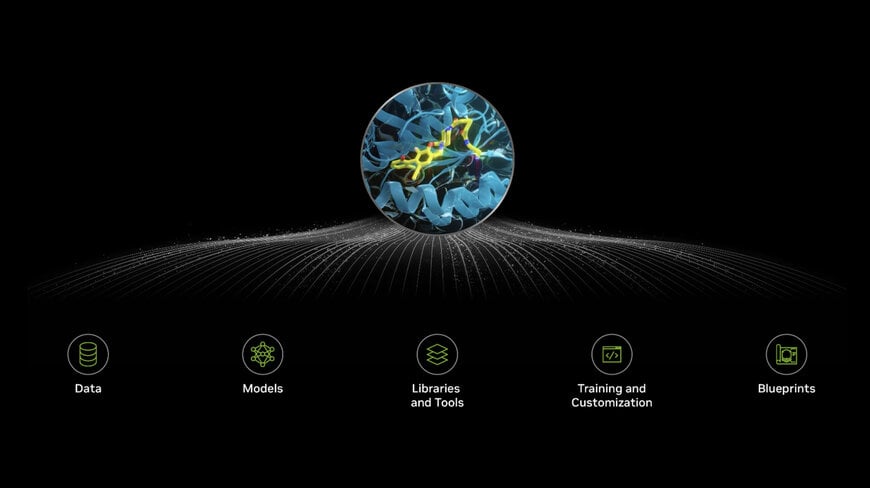
NVIDIA has expanded its BioNeMo platform, positioning it as a core infrastructure layer for AI-driven biology and drug discovery by connecting model development, laboratory experimentation and automation into integrated workflows.
BioNeMo is an open development platform designed to support lab-in-the-loop processes across the full AI lifecycle, from data generation and processing to model training, optimization and deployment. The expansion addresses the scale and complexity of scientific data generated by the life sciences sector, where annual research and development costs are estimated at approximately $300 billion.
Platform extensions for biological modeling
The latest BioNeMo update introduces additional open models and tools aimed at improving the practicality and scalability of AI-driven discovery. New NVIDIA Clara models include RNAPro for RNA structure prediction and ReaSyn v2, which focuses on assessing the synthetic feasibility of AI-designed drug candidates.
The platform now also includes BioNeMo Recipes, intended to streamline the training, customization and deployment of biological foundation models, as well as GPU-accelerated data processing libraries such as nvMolKit for cheminformatics and molecular design. Together, these components are designed to reduce iteration cycles between experimental data generation and model refinement.
Integration with laboratory workflows
NVIDIA is working with life sciences organizations to embed BioNeMo directly into laboratory environments, closing the loop between experimentation and AI. This approach allows experimental results to continuously inform model updates, supporting predictive and adaptive research workflows rather than isolated computational analysis.
A central element of this strategy is enabling agentic AI systems that can coordinate experiments, analyze results and propose next steps with limited human intervention, while remaining connected to physical laboratory instruments.
Pharmaceutical and instrumentation collaborations
Eli Lilly and Company has announced a collaboration with NVIDIA to establish a co-innovation AI lab focused on addressing persistent challenges in drug discovery. The initiative combines NVIDIA’s accelerated computing, AI and robotics technologies with Lilly’s drug development expertise and builds on Lilly’s existing NVIDIA DGX SuperPOD infrastructure. The program is expected to expand over five years, with investments in talent, compute and next-generation architectures.
In parallel, Thermo Fisher Scientific is collaborating with NVIDIA to develop autonomous laboratory infrastructure. The effort integrates NVIDIA’s edge-to-cloud computing stack with laboratory instrumentation to support high-throughput experiment orchestration, autonomous protocol execution and real-time data analysis using BioNeMo tools.
Ecosystem adoption and physical AI
BioNeMo is being adopted across a growing ecosystem of biotechnology, pharmaceutical and AI research companies to scale biological model development and molecular design. In parallel, NVIDIA is extending its physical AI technologies into laboratory automation through simulation, robotics and digital twins, enabling tighter coupling between in-silico modeling and real-world validation.
By linking AI agents, laboratory automation and scientific data pipelines, BioNeMo is intended to support industrial-scale discovery workflows where experimentation, analysis and model development evolve continuously. This integration reflects a broader shift toward data-centric, automated research environments in life sciences and drug discovery.
www.nvidia.com
