
electronics-journal.com
19
'25
Written on Modified on
Low-Saturation Bipolar Transistors for Automotive Power Switching
Diodes Incorporated expanded its automotive bipolar transistor lineup to improve conduction efficiency and thermal performance in compact 12 V, 24 V, and 48 V vehicle power systems.
www.diodes.com
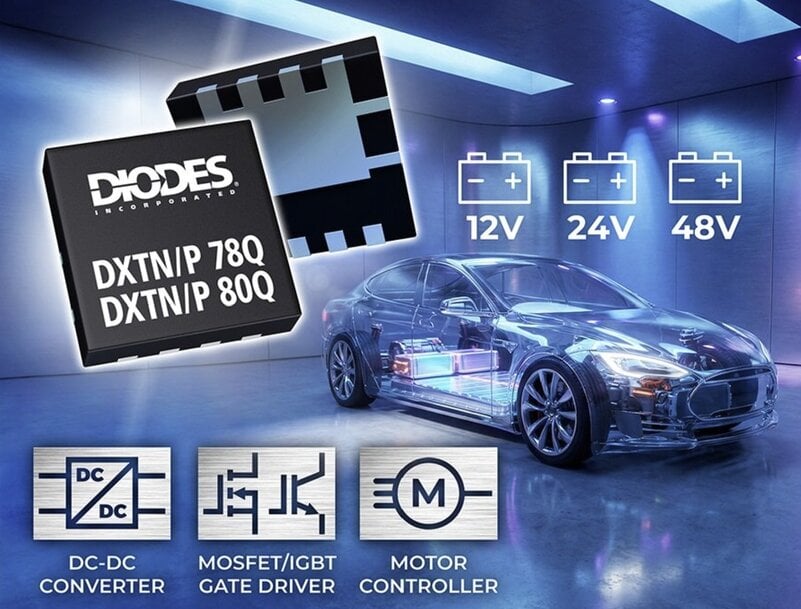
Diodes Incorporated introduced the DXTN/P 78Q and 80Q series of new automotive-compliant NPN and PNP bipolar transistors designed for power switching and control functions where low conduction loss, high current capability, and compact packaging are required. The devices target automotive electronics such as power distribution, motor control, and voltage regulation operating under elevated temperature and reliability constraints.
Addressing efficiency limits in automotive power stages
The newly added devices were developed to reduce saturation voltage in bipolar transistor stages, directly lowering conduction losses in automotive power paths. By achieving ultra-low VCE(sat), the transistors reduce power dissipation during continuous operation, supporting higher power density and improved thermal margins in space-constrained electronic control units.
The portfolio consists of twelve devices spanning collector-emitter breakdown voltages from 30 V to 100 V, aligning with common automotive electrical architectures including 12 V, 24 V, and emerging 48 V systems. This range allows designers to use the same device family across multiple vehicle subsystems while meeting voltage derating requirements.
Suitability for high-current switching and control tasks
The transistors are intended for roles such as driving MOSFETs and IGBTs, power line and load switching, low-dropout voltage regulation, DC-DC conversion, and the actuation of motors, solenoids, relays, and valves. Devices in the higher-rated series support continuous collector currents up to 10 A, with peak pulse capability reaching 20 A, providing margin for transient load conditions common in automotive environments.
Operational reliability is supported by a maximum junction temperature rating of +175 °C, enabling continuous use near heat-generating components. The devices also incorporate electrostatic discharge protection rated at 4 kV human body model (HBM) and 1 kV charged device model (CDM), addressing handling and assembly risks in automotive manufacturing.
Compact packaging and thermal management considerations
The devices are housed in the PowerDI®3333-8 surface-mount package, measuring 3.3 mm × 3.3 mm. Compared with legacy SOT223 packages, this format can reduce PCB footprint by up to 75%, allowing additional circuitry or higher channel density within the same board area.
Thermal performance is enhanced through a large underside heatsink that delivers a junction-to-lead thermal resistance (RθJL) of 4.2 °C/W, supporting efficient heat transfer into the PCB. A side-wall plateable feature improves automated optical inspection visibility and reinforces solder joints, contributing to manufacturing consistency and reduced inspection effort.
Measurable gains in conduction and thermal performance
At the device level, saturation voltages as low as 17 mV at 1 A and on-state resistance down to 12 mΩ directly translate into lower I²R losses during operation. According to Diodes Incorporated, these characteristics enable up to a 50% reduction in conduction losses compared with earlier generations, helping designers limit heat generation and simplify thermal management in compact automotive electronics.
Together, the electrical, thermal, and packaging characteristics position the new DXTN/P 78Q and 80Q series as building blocks for higher-efficiency automotive power switching and control circuits operating under increasing current density and temperature demands.
www.diodes.com
