
electronics-journal.com
10
'25
Written on Modified on
Confocal Chromatic Sensors for High-Temperature and Vacuum Measurements
Micro-Epsilon expands its sensor portfolio with temperature- and vacuum-resistant confocal chromatic displacement sensors for precise distance and thickness measurements up to 200 °C.
www.micro-epsilon.com
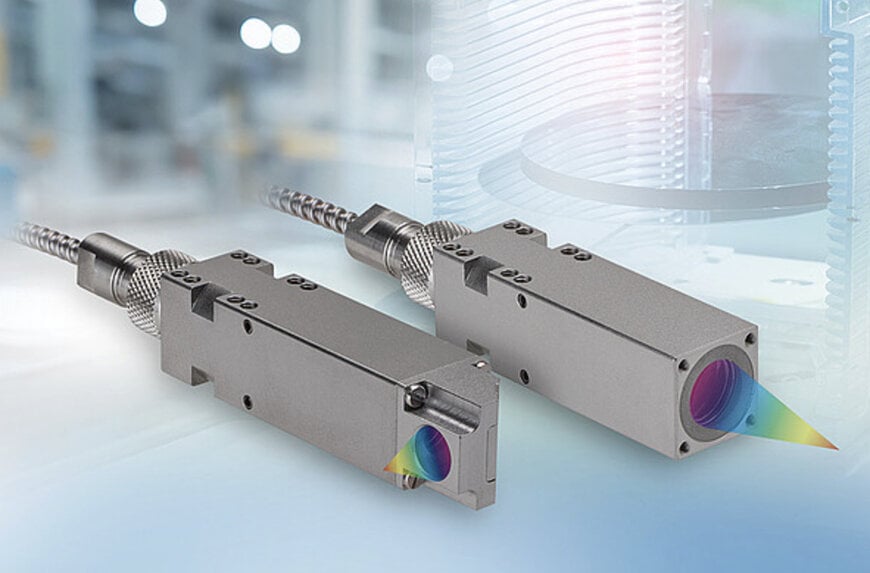
Semiconductor manufacturing, precision engineering and vacuum technology impose particularly stringent requirements on optical measurement systems, especially in terms of temperature resistance, outgassing behavior and measurement stability. A new generation of high-temperature confocal chromatic sensors addresses these requirements by combining vacuum-compatible design with stable micrometer-level resolution at temperatures of up to 200 °C.
The sensors are designed for displacement, distance and thickness measurements on both reflective and diffuse surfaces. Their primary application fields include temperature-critical processes in the semiconductor and electronics industries as well as highly dynamic applications in precision mechanical engineering.
Vacuum-Compatible Design up to Ultra-High Vacuum
These high-temperature sensors are the first optical sensors in the portfolio of Micro-Epsilon that can be operated continuously at temperatures of up to 200 °C. The complete elimination of organic adhesives significantly reduces outgassing. The stainless-steel housing and the fully passive component design prevent additional heat input into the surrounding environment.
These structural features enable sensor operation up to the ultra-high vacuum (UHV) range. At the same time, the sensors do not emit any relevant thermal radiation into the measurement process, which is particularly important for temperature-sensitive semiconductor applications.
Measurement Accuracy and Thermal Stability
The confocal chromatic sensors achieve a linearity of up to < ±0.18 µm and a temperature stability of up to < 0.1 µm/°C. This ensures reproducible measurement results even under strongly fluctuating thermal conditions. The sensors are therefore suitable for applications in which the smallest positional or thickness changes must be detected, such as in wafer processing, electronics manufacturing or high-precision mechanical machining.
Compact Design for Space-Constrained Installations
The sensors are designed for use in space-restricted environments. In addition, versions with a 90° beam path are available to further reduce the required installation depth. This allows integration into existing systems where space for measurement technology is structurally limited.
The available measurement ranges of 0.8 mm, 2 mm and 4 mm cover typical applications in fine and micro-scale metrology. Signal processing is performed via confocal chromatic IFC controllers, with which the sensors are fully compatible.
Technical Positioning Compared with Existing Measurement Solutions
Confocal chromatic sensors are well established for high-precision optical displacement and thickness measurements. The sensor platform presented here extends this measurement principle for the first time in the Micro-Epsilon portfolio to include continuous high-temperature capability up to 200 °C combined with UHV compatibility. In this combination of temperature range, vacuum capability, passive design and micrometer-level resolution, comparable optical sensors are currently only available on the market to a limited extent.
What Makes These Sensors Technically New
The technical innovation lies not only in the measurement principle itself, but in the combination of confocal chromatic optics, adhesive-free stainless-steel construction, fully passive design and verified UHV compatibility with simultaneously high thermal stability. This opens up application areas that previously had to be covered mainly by special tactile systems or optoelectronic solutions located outside the hot zone.
www.micro-epsilon.com
