
electronics-journal.com
10
'25
Written on Modified on
AMD introduces EPYC Embedded 2005 processors for compact, power-efficient infrastructure systems
Designed for constrained networking, storage and industrial equipment, AMD’s new EPYC Embedded 2005 series combines Zen 5 compute density, scalable I/O and long-life support for 24/7 embedded workloads.
www.amd.com
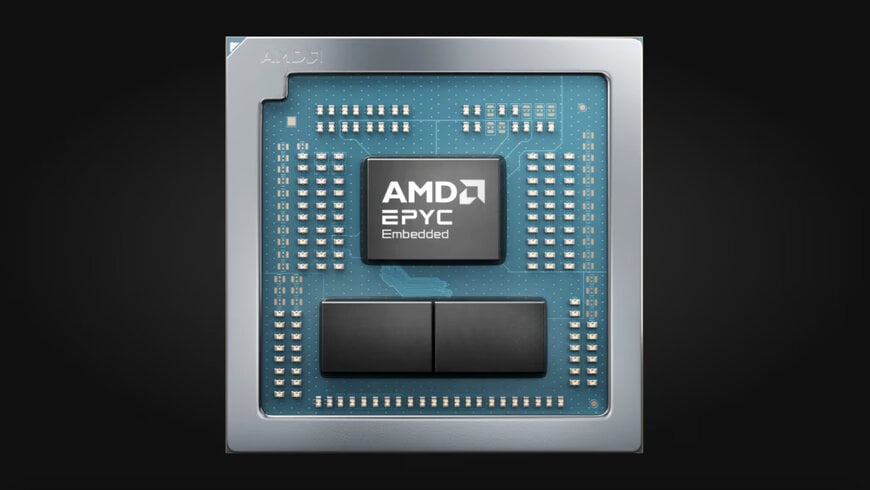
Higher compute density for space- and power-restricted designs
AMD has expanded its embedded processor portfolio with the EPYC Embedded 2005 Series, a BGA-mounted processor family aimed at networking, storage and industrial systems where board space, thermal headroom and continuous uptime are critical. The devices are intended for switches, routers, DPU control planes, cold storage arrays, aerospace computing and robotics platforms that increasingly need stronger performance per watt in compact hardware.
The processors integrate up to 16 Zen 5 x86 cores, 64 MB shared L3 cache, and a configurable 45–75 W TDP, allowing system designers to match performance to thermal constraints. Their 40 mm × 40 mm BGA footprint is 2.4× smaller than Intel’s Xeon 6500P-B package¹, enabling tighter layouts and simplified thermal management through shorter signal paths and increased I/O density.
AMD specifies up to 28 % higher boost frequency and 35 % higher base frequency at half the TDP of the Intel Xeon 6503P-B², positioning the series for high compute density in systems that cannot accommodate larger heat-dissipating structures or high-power processors.
Architecture optimized for continuous industrial operation
The EPYC Embedded 2005 platform is engineered for 24/7 deployment with up to 10 years of field operation, supported by long-term component availability and 15 years of software maintenance. This lifecycle target is aimed at network appliances, industrial controllers and storage systems where redesign costs must be minimized.
To support uptime, the processors include comprehensive RAS (Reliability, Availability, Serviceability) capabilities for error detection and correction. Application-specific features—such as BMC support, PCIe Hot Plug, and multi-SPI ROM—address the integration needs of network switches, carrier-grade systems and modular storage hardware.
Security functionality is provided through AMD Infinity Guard, incorporating the AMD Secure Processor³, Platform Secure Boot, and Memory Guard to protect data and system state against firmware and memory attacks in mission-critical deployments.
Scalable connectivity and software support
With 28 lanes of PCIe Gen5, the devices offer flexible integration of Ethernet controllers, accelerators, FPGAs or proprietary ASICs. Up to 16 aggregated lanes can be allocated to high-speed networking devices, supporting evolving bandwidth demands in edge and data-center-adjacent infrastructure.
Support for DDR5 memory enables higher data throughput and provides a migration path as DDR4 components progress toward end-of-life. This is relevant for embedded systems expected to remain in service for more than a decade.
The processors rely on an open software ecosystem including upstream support for Yocto, kernel drivers, and EDK II, reducing integration barriers and shortening development cycles for custom embedded platforms.
Embedded computing for next-generation connected systems
As embedded infrastructure increasingly incorporates AI inference, deterministic networking and high-bandwidth storage, the EPYC Embedded 2005 Series offers a balance of compute capability, power efficiency and longevity that suits the next wave of compact, continuously operating systems. With Zen 5 cores, robust security blocks and scalable I/O, the platform is positioned to support AI-enabled switches, industrial controllers, edge servers and mission-critical robotics.
Footnotes:
1. Based on AMD internal analysis as of November 2025. AMD EPYC™ Embedded 2005 Series has a 40mm x 40mm (1,600mm2) BGA package size. Intel Xeon™ 6500P-B Series has a 77.5mm x 50mm (3,875mm2) BGA package size.
(3,875mm2 – 1,600mm2) / 1,600 mm2 =142% smaller package area or 2.42x smaller
Intel Xeon 6500P-B Processor specifications: EE2-003
2. Based on AMD internal analysis as of November 2025. AMD EPYC™ Embedded 2655 is a 12-core “Zen 5” processor model with a 4.5GHz 1T Boost CPU frequency.
Intel Xeon™ 6503P-B is a 12-core processor model with a 3.5GHz Boost CPU frequency.
Intel Xeon™ 6516P-B is a 20-core processor model with a 3.5GHz Boost CPU frequency.
(4.5 GHz – 3.5 GHz) / 3.5 GHz = 28% higher Boost CPU frequency or 1.28x better.
Intel Xeon™ 6503P-B specifications
Intel XeonTM 6516P-B specifications: EE2-005
Based on AMD internal analysis as of November 2025. AMD EPYCTM Embedded 2655 is a 12-core “Zen 5” processor model with a 2.7 GHz Base CPU frequency and 55W nominal TDP.
Intel XeonTM 6503P-B is a 12-core processor model with a 2.0 GHz Base CPU frequency and 110W nominal TDP
(2.7 GHz – 2.0 GHz) / 2.0 GHz = 35% higher Base CPU frequency or 1.35x better
(110W – 55W) / 100W = 0.5x or half the TDP
Intel XeonTM 6503P-B specifications: EE2-004
3. The AMD Secure Processor is a dedicated on-chip security processor integrated within each system-on-a-chip (SoC) and ASIC (Application Specific Integrated Circuit) designed by AMD. It enables secure boot with root of trust anchored in hardware, initializes the SoC through a secure boot flow, and establishes an isolated Trusted Execution Environment. GD-72.
www.amd.com
